- Home
- /
- Cyber Security
- /
- Cyber Security
Cyber Security
Comprehensive Cyber Security Course for Beginners – Learn Ethical Hacking & Network Protection
Cyber Security Course in Nepal
Learn ethical hacking, penetration testing, and offensive security — Nepal's most affordable cybersecurity training.
If you're searching for the best Cyber Security course in Nepal, this is it. Code IT's 1-month offensive cybersecurity training is the most comprehensive ethical hacking program in Nepal — covering network security, penetration testing, OSINT, Nmap, Nessus, Burp Suite, Wireshark, OWASP Top 10, malware analysis, social engineering, and real-world vulnerability assessment — everything you need to start a career in Nepal's fast-growing cybersecurity industry.
Cyber attacks on Nepal's banks, government systems, and businesses are increasing every year. Ethical hackers and penetration testers — the professionals who find vulnerabilities before criminals do — are among the most urgently needed and highest-paid IT specialists in Nepal right now. This course teaches you exactly how they work.
You won't just study theory. You'll use Wireshark to capture and analyze live network traffic, perform footprinting and reconnaissance using OSINT tools like Google Dorking, Shodan, and Maltego, scan networks with Nmap and Netcat, assess vulnerabilities with Nessus, test web applications for SQL Injection, XSS, and CSRF using Burp Suite, analyze malware with VirusTotal and sandboxes, and work through the complete penetration testing lifecycle — Recon, Scanning, Exploitation, and Reporting.
You'll also cover cybersecurity laws and ethics — GDPR, ISO 27001, PCI-DSS, and Nepal's IT Act — responsible disclosure, and the career paths, certifications (CEH, Security+, CISSP), and job roles that Nepal's cybersecurity sector is built around.
Live classes run from 8:00 PM to 9:30 PM via Google Meet, accessible from Kathmandu, Pokhara, Biratnagar, Butwal, Chitwan, or anywhere in Nepal. Classroom sessions available in Dharan. No coding required — basic networking and Linux familiarity is an advantage.
Every student receives lifetime video access and an industry-recognized certificate from Code IT.
Learn ethical hacking, penetration testing, and offensive security — Nepal's most affordable cybersecurity training.
If you're searching for the best Cyber Security course in Nepal, this is it. Code IT's 1-month offensive cybersecurity training is the most comprehensive ethical hacking program in Nepal — covering network security, penetration testing, OSINT, Nmap, Nessus, Burp Suite, Wireshark, OWASP Top 10, malware analysis, social engineering, and real-world vulnerability assessment — everything you need to start a career in Nepal's fast-growing cybersecurity industry.
Cyber attacks on Nepal's banks, government systems, and businesses are increasing every year. Ethical hackers and penetration testers — the professionals who find vulnerabilities before criminals do — are among the most urgently needed and highest-paid IT specialists in Nepal right now. This course teaches you exactly how they work.
You won't just study theory. You'll use Wireshark to capture and analyze live network traffic, perform footprinting and reconnaissance using OSINT tools like Google Dorking, Shodan, and Maltego, scan networks with Nmap and Netcat, assess vulnerabilities with Nessus, test web applications for SQL Injection, XSS, and CSRF using Burp Suite, analyze malware with VirusTotal and sandboxes, and work through the complete penetration testing lifecycle — Recon, Scanning, Exploitation, and Reporting.
You'll also cover cybersecurity laws and ethics — GDPR, ISO 27001, PCI-DSS, and Nepal's IT Act — responsible disclosure, and the career paths, certifications (CEH, Security+, CISSP), and job roles that Nepal's cybersecurity sector is built around.
Live classes run from 8:00 PM to 9:30 PM via Google Meet, accessible from Kathmandu, Pokhara, Biratnagar, Butwal, Chitwan, or anywhere in Nepal. Classroom sessions available in Dharan. No coding required — basic networking and Linux familiarity is an advantage.
Every student receives lifetime video access and an industry-recognized certificate from Code IT.
Prerequisites
Cyber Security

Have any Question?
Everything You Receive
All-inclusive support — from training to real-world experience
Live Classes
Google
Meet
8:00 - 9:30 pm
Lifetime Videos
Re-watch anytime
Certification
Industry recognized
Internship
No internships are available right now.
Course Curriculum
Everything you'll learn — from fundamentals to advanced concepts
Course Outlines
-
Cyber Security Fundamentals
-
Network & System Security
-
Ethical Hacking & Penetration Testing
-
Web & Application Security
-
Cyber Security Tools & Real-World Projects
Full Curriculum
01
Day 1 — Cyber Security + Complete Lab Setup
02
Day 2 — Networking + Lab Verification
03
Day 3 — Linux for Cyber Security
04
Day 4 — Windows Security Fundamentals
05
Day 5 — Cryptography & Security Fundamentals
06
Day 6 — Security Fundamentals Mini Project
07
Day 7 — Reconnaissance & OSINT
08
Day 8 — Network Scanning & Enumeration
09
Day 9 — Vulnerability Assessment
10
Day 10 — Web Application Security
11
Day 11 — OWASP Top 10
12
Day 12 — Web Security Assessment Project
13
Day 13 — Metasploit & Controlled Exploitation
14
Day 14 — Password & Authentication Security
15
Day 15 — Network Defense & Security Controls
16
Day 16 — Cloud Security I
17
Day 17 — Cloud Security II
18
Day 18 — Security Monitoring & SIEM
19
Day 19 — Digital Forensics
20
Day 20 — Incident Response
21
Day 21 — SOC Analyst Practical
22
Day 22 — Cyber Security Governance, Risk & Compliance
23
Risk Management
24
Day 23 — Secure Coding & API Security
25
Day 25 — Professional Penetration Testing Methodology
26
Day 25 — Professional Penetration Testing Methodology
27
Day 26 — Web Application Security Assessment
28
Day 27 — Network Security Assessment
29
Day 28 — SOC & Incident Response Simulation
30
Day 29 — Final Cyber Security Capstone
31
Day 30 — Final Presentation + Career Preparation
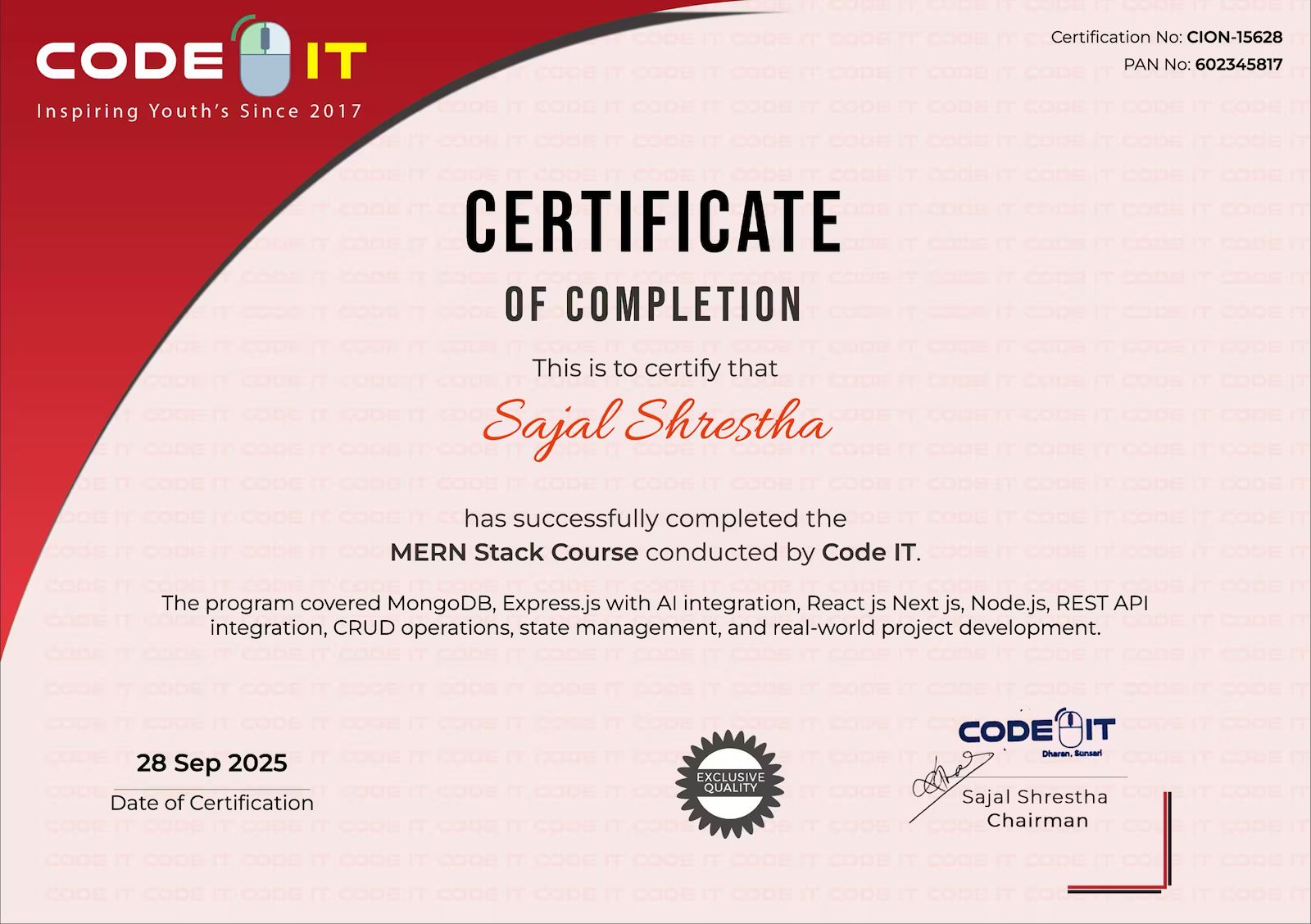
Earn Your Certification
After completing the course, you will receive a professional certificate from Code IT, verified by industry leaders in Nepal.
Course Mentors
Learn directly from industry experts with years of hands‑on experience

Badri Tamang
Certified Security Specialty
As a seasoned IT professional with expertise in Technical Support, Hardware & Network Troubleshooting, Basic SIEM & SOC knowledge, I have a proven track record of providing exceptional service to clients.
I excel in providing technical support to end-users, diagnosing and resolving hardware and software issues, and troubleshooting network connectivity problems. My knowledge of Basic SIEM & SOC has allowed me to effectively protect and defend networks against cyber attacks, and my preparation for N+/CEH has given me a deep understanding of network security concepts.
Throughout my career, I have successfully designed and implemented cybersecurity protocols to protect sensitive data and prevent cyber attacks. I have also demonstrated expertise in networking protocols, server administration, and cloud computing. My strong background in Information Systems has allowed me to develop and maintain efficient and effective systems that support business operations.
Overall, I'm a results-oriented professional with a passion for technology and a strong commitment to providing exceptional service to clients.
Need More Information?
Our team will respond within a few hours
Why Enquire?
Join 100k+ successful graduates
Similar Courses
Explore other programs that might interest you